
PayPal Holdings Inc. is one of the most established digital payment platforms globally. Founded in 1998, the company has been a pioneer in online payments, providing secure and efficient transaction solutions for individuals and businesses. Operating in over 200 countries, PayPal serves more than 430 million active accounts and processes billions of transactions annually.
The company generates approximately 90% of its revenue from transaction fees, with additional income from services like Venmo, credit offerings, and value-added financial products. Despite growing competition from fintech startups and traditional banks, PayPal remains a dominant player due to its strong brand, extensive user base, and continuous innovation in digital finance.
PayPal’s stock has seen significant volatility, rising nearly 40% in 2024 but falling over 10% year-to-date in 2025, underperforming the general market, which is up 3% YTD. The recent Q4 earnings report highlighted both strengths and weaknesses in PayPal’s business, causing investor concerns. While key metrics like active accounts and branded checkout transactions have shown resilience, the decline in unbranded processing growth (Braintree) has weighed heavily on overall sentiment. Despite this, PayPal continues to generate record free cash flow and has an aggressive share buyback strategy, reinforcing its long-term fundamentals. The big question: Is the selloff a long-term opportunity, or a warning sign for deeper structural issues?
The primary reason for the recent sell-off is the slowdown in PayPal’s unbranded payment processing business (Braintree), which had been a major growth driver. While the company is shifting its focus toward higher-margin transactions, this transition has temporarily impacted revenue growth, causing concern among investors.
Management has emphasized that these changes are intentional and aimed at improving profitability over the long term. PayPal also continues to execute an aggressive $15 billion share repurchase program, reducing the number of outstanding shares and increasing earnings per share (EPS).
From a valuation standpoint, PayPal is trading at a price-to-earnings (P/E) ratio of 19x and a price-to-free-cash-flow (P/FCF) ratio of 11.7x, making it one of the cheapest large-cap fintech stocks. With improving profitability and record-high free cash flow, the stock appears undervalued relative to historical levels.
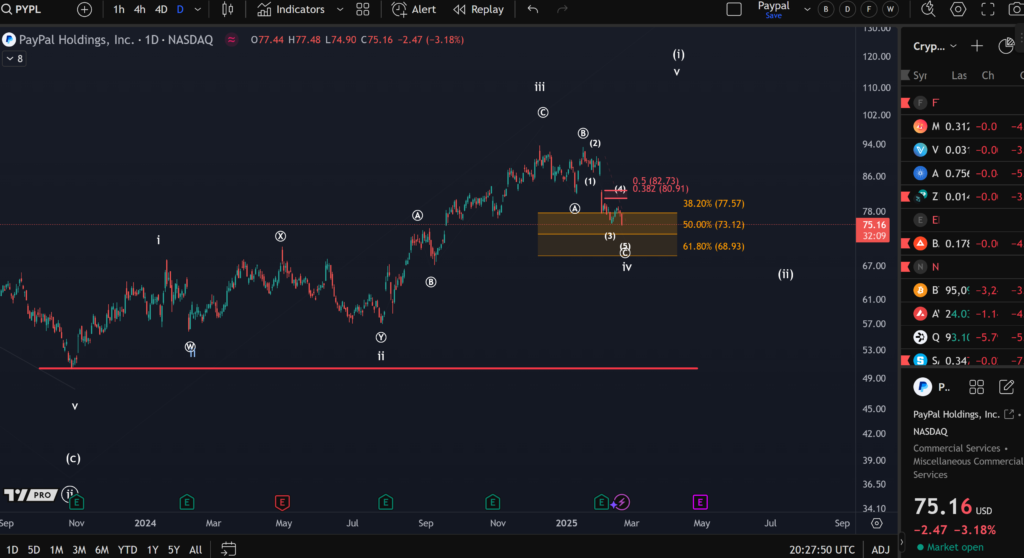
PayPal likely completed a large wave 2 correction at the end of 2023, suggesting that the stock has already formed a long-term bottom and is positioned for a sustained recovery.
The stock is currently undergoing a fourth-wave pullback within a larger uptrend. While this corrective phase is still unfolding, the long-term bullish structure remains intact, and a fifth-wave rally is expected once the pullback is complete.
PayPal’s broader market structure remains bullish, but confirmation of a bottom is still required. A final push lower is possible before the uptrend resumes.
If the stock holds support within the $69-$77 range, it is likely to move toward the $98-$105 target area in the coming months. However, a break below $68.93 would suggest further downside risk before a recovery.
Despite short-term challenges, PayPal remains a fundamentally strong company. While revenue growth has slowed due to strategic business adjustments, the company’s focus on higher-margin transactions, record-high free cash flow, and a robust share buyback program provide a solid foundation for long-term growth.
From an Elliott Wave perspective, PayPal is in a bullish structure, with a potential wave five rally toward $98-$105 once a bottom is confirmed.
For long-term investors, PayPal appears undervalued based on its financial position and growth potential. The current support range could offer an attractive entry point if support holds, providing a favorable risk-reward scenario for those looking to benefit from a long-term uptrend.
