Bitcoin’s market cycles have historically followed four-year halving cycles, leading to parabolic bull runs followed by deep corrections. However, the current cycle exhibits key differences that make direct comparisons to previous bull markets unreliable.
1. How Previous Cycles Played Out
In 2013, 2017, and 2021, Bitcoin followed a pattern of:
- Rapid Expansion: Price surged post-halving, leading to parabolic moves.
- Euphoria and Blow-Off Top: A speculative frenzy pushed prices to unsustainable levels.
- Massive Crash: An 80-90% drawdown followed, wiping out retail investors.
However, this cycle does not follow the same playbook due to structural shifts in Bitcoin’s market dynamics.
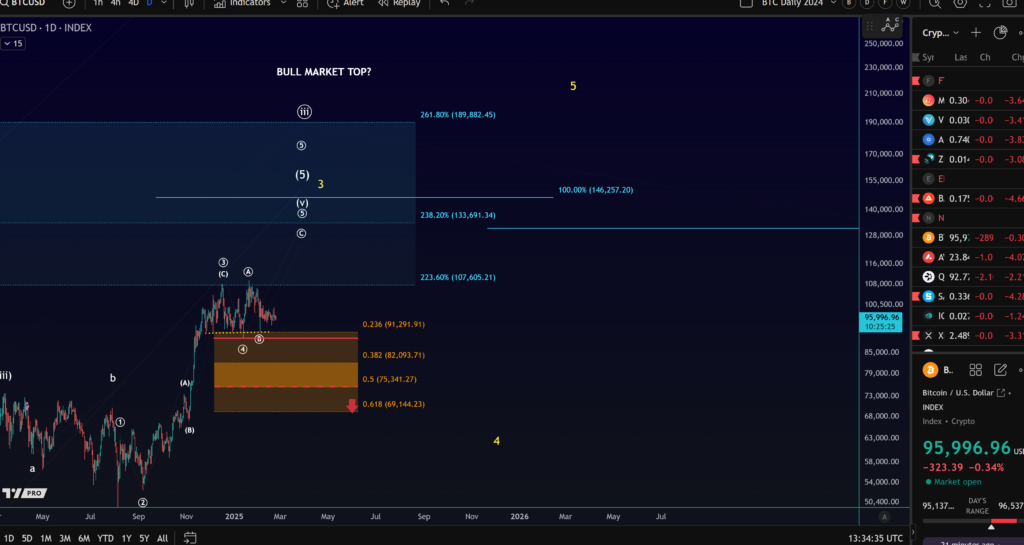
2. Why This Cycle is Different

A Smaller Degree Fifth Wave?
- From an Elliott Wave perspective, Bitcoin is currently in a fifth wave of a smaller degree than in previous cycles.
- This suggests that expecting a massive, extended bull run like 2017 or 2021 may not be realistic.
Market Maturity and Institutional Players
- Institutional adoption has changed Bitcoin’s behavior. Large players are less speculative and more strategic, leading to less volatility compared to retail-driven markets of the past.
- Unlike earlier cycles, where altcoins surged massively, this time altcoin performance is inconsistent, further signaling a different structure.
Bitcoin Miners Are Underperforming
- In past cycles, Bitcoin miner stocks outperformed Bitcoin itself.
- In 2024, miners are struggling, suggesting that the market is less healthy than in previous cycles.
- This weak miner performance contradicts the “super cycle” narrative that some analysts push.
The Myth of the Four-Year Halving Cycle
- Some traders still rely on the four-year cycle thesis, expecting Bitcoin to peak 12-18 months post-halving (which would place a potential peak in late 2025).
- However, Bitcoin has evolved, and assuming this cycle will follow the same trajectory as 2017 or 2021 is a mistake.
- Elliott Wave analysis suggests that we may already be in the final stretch of this bull market, with $130K as a possible top.
3. The Role of Altcoins: Why This Cycle is Weaker for Alts
Previous Cycles: Altcoin Booms
- In 2017, altcoins experienced a parabolic rally following Bitcoin’s peak.
- In 2021, Layer 1 blockchains like Solana and Avalanche saw massive gains as speculation peaked.
Current Cycle: Selective Altcoin Growth
- Not all altcoins are rallying. Some have shown strong moves (like Solana), but others have failed to gain traction.
- Ethereum, which used to lead altcoin seasons, is underperforming compared to Bitcoin.
- Speculative money is flowing more cautiously, making this cycle less explosive for altcoins.
Key Takeaway:
💡 This cycle is different from past altcoin seasons. Not all altcoins will pump—only select, high-quality projects will benefit.
4. The Likely Path Forward
Scenario 1: Bitcoin Topping at $130K
- If Bitcoin reaches $130K, we should expect a multi-month correction.
- A break below $69K would signal that the top is in.
- A drop to $85K could be the last major buying opportunity before another move up.
Scenario 2: Extended Cycle Hypothesis (Less Likely)
- Some argue that Bitcoin could extend beyond 2025 before topping.
- This would require major new inflows from institutional money.
- If Bitcoin miners suddenly show strength and altcoins begin rallying across the board, this could support an extended cycle.
5. Trading Strategy for This Cycle
Lessons from Previous Cycles:
✅ Don’t assume history will repeat exactly—this cycle has unique characteristics.
✅ Manage risk at key resistance levels instead of trying to call an exact top.
✅ Altcoin selection is critical—throwing money at random projects is no longer a viable strategy.
What Smart Traders Should Do Now:
🔹 Avoid overexposure at current levels—Bitcoin is closer to a potential top than the beginning of a new bull phase.
🔹 Be cautious about new altcoin investments—focus on strong, trending assets rather than speculative plays.
🔹 Watch Bitcoin miners—if they remain weak, it’s a warning sign for the market.
🔹 Prepare for a major correction—Bitcoin may drop to $85K-$87K before making a final push higher.
Conclusion
Bitcoin’s current cycle differs from past cycles in key ways, and traders must adapt accordingly.
- A top at around $130K is likely, but confirmation will come only with a break below $69K.
- Altcoins are not following past patterns, making selective investing more important than ever.
- Bitcoin miner weakness is a major red flag, signaling that this cycle may be weaker than previous ones.
The biggest takeaway? This is not a copy-paste of 2017 or 2021. Traders who recognize these differences and adapt will outperform those relying on outdated models.